
The Dashboard Delusion: Confusing Metrics with Momentum




Every year, organizations invest millions in business intelligence platforms, hiring data teams, building sophisticated dashboards, and collecting vast amounts of data. Yet in boardrooms across industries, decisions are still being made on gut feeling, spreadsheets someone casually forwarded, or whatever information happened to be at hand. This isn't a story about bad tools, it's a story about a fundamental disconnect between insight and action.
The traditional model for business intelligence has long followed a linear path: collect data, clean and prepare it, explore and model it, and finally, package it into dashboards and reports. But no matter how sophisticated the pipeline, it ultimately falls short if the insights generated don't translate into real-world actions or measurable business outcomes.
The Last-Mile Problem
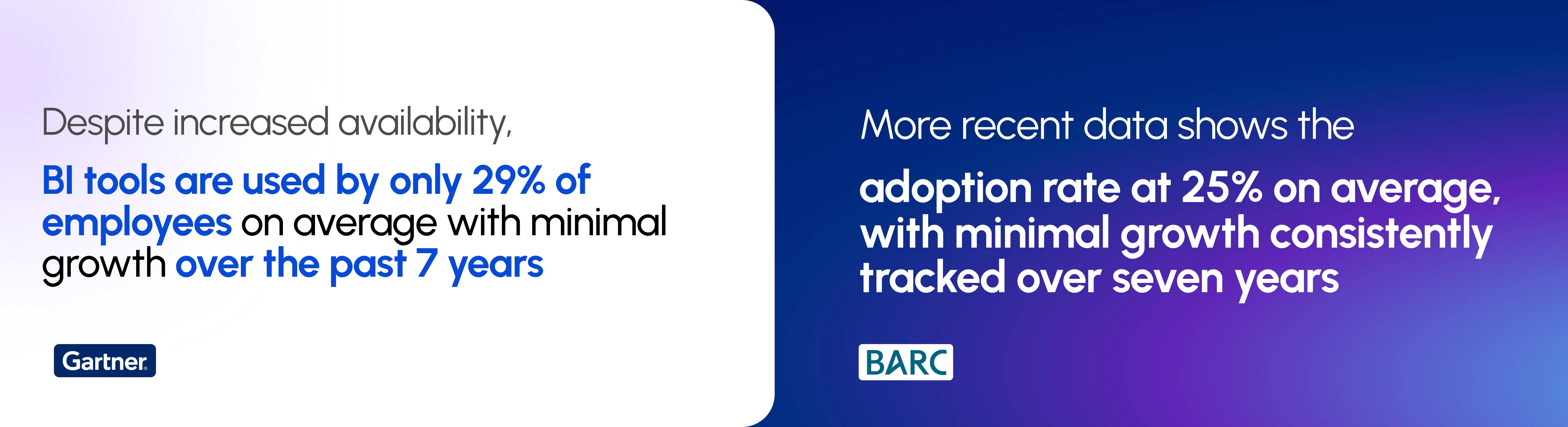
Here's the uncomfortable truth: despite the investment, business intelligence and analytics tools are still only used by 29% of employees on average, with minimal growth over the past seven years. Organizations have built the infrastructure, trained teams, and rolled out beautiful dashboards yet the majority of their workforce still isn't using them to inform their decisions.
This isn't because dashboards are visually polished. It's because they sit outside the flow of daily work, with insights siloed and disconnected from the operational systems where decisions are made and actions are taken. For sales teams juggling CRM systems, customer service departments navigating support software, or operations leaders managing supply chains, visiting a separate analytics portal feels like just another tab to open when momentum matters most.
Why Dashboards Fail to Drive Decisions
The gap between available data and actionable insight reveals itself in multiple ways:
- Dashboards built in isolation. Generic dashboards often miss the specific metrics decision-makers need. The solution: anchor every BI initiative in specific business decisions from the start. Ask what you want to improve and design with that decision-maker in mind, instead of vague generic goals.
- Information overload. Too many metrics shift the analytical burden to viewers, who ignore it or confirm existing beliefs. The solution: every metric must directly support a decision. During migration, standardize reporting and enforce governance to prevent dashboards from becoming a dumping ground for data.
- Strategic misalignment. BI initiatives fail when driven by available data rather than business outcomes. Insights become intellectual exercises instead of catalysts for action. Treat migration as business transformation with executive sponsorship. The solution: BI leaders must maintain executive sponsorship and involvement by treating migration as business transformation, instead of a glorified IT upgrade.
- Lack of context. A 3.2% conversion rate is meaningless without context like target, trend, revenue impact. Raw numbers divorced from operational significance create confusion, not clarity. The solution: Invest in training employees to both interpret and act on insights.
Timing and Real-Time Responsiveness
The problem deepens when speed matters. In fast-moving sectors such as finance, retail, or technology, delays in BI reporting can be particularly detrimental, affecting everything from customer satisfaction to revenue generation. Even when insights are accurate, they're often delayed, static, or detached from operational systems. This disconnect prevents users from responding in the moment when action is most valuable.
The Cultural and Structural Barriers
Beyond design flaws, organizational obstacles persist. Companies struggle with reluctance within the organization to embrace data analysis as a strategic function. Sometimes data isn't seen as the most valuable asset, or when it is, it's used to make a point instead of helping teams move forward.

Additionally, many organizations struggle with IT silos where departments fail to integrate and deliver the most complete and relevant data, leading to erroneous or incomplete operational and analytical data.
Closing the Insight-Action Gap
High-performing organizations are nearly twice as likely to have identified and prioritized specific decision-making processes in which to embed analytics. The difference isn't the tools; it's the approach.
The future of business intelligence isn't about collecting more data or building prettier dashboards. It's about closing the gap between insight and action by transforming analytics from passive observation into active decision-making by establishing clear guidelines as to what happens when data signals a problem.
Ready to turn your data into real business outcomes?
NCRi's Data Analytics operations help organizations redesign their BI infrastructure to drive decisions that matter. From strategy and architecture to implementation and optimization, we'll help you close the insight-action gap. Learn how we can transform your analytics.


